


HOW DO BRAKES WORK? Part 3 – Power Brakes and Antilock Brakes
November 19, 2010 | in Defensive Driving TipsPower Brakes
While drum brakes provide some additional power assist, as we saw in the discussion in Part 2 of this series, disc brakes don’t. In most cars with disc brakes, additional force multiplication is needed in order to make the brakes effective and easy to operate. This power is provided by the vacuum booster; cars that use a vacuum booster are said to have power brakes.
The vacuum booster–a large, flat cylinder–is easy to locate in the engine. (See Figure 10)
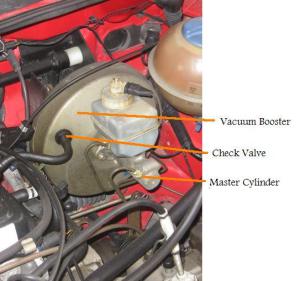
Figure 10: a vacuum booster
As you can see, the vacuum booster is connected directly to the master cylinder. A hose also connects the vacuum booster to the engine via the check valve. The engine, which generates vacuum naturally as it functions, removes air from the vacuum booster, while the check valve ensures that air doesn’t enter the vacuum booster when the engine shuts off.
The vacuum booster uses vacuum power to increase the force provided by the brake pedal. A shaft passes directly from the brake pedal, through the vacuum booster, to the master cylinder (Figure 11).
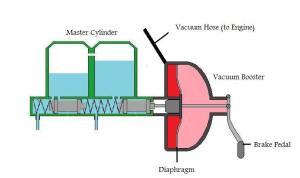
Figure 11: Inside a vacuum booster
As you can see, there is a diaphragm inside the vacuum booster that separates the end of the booster nearest the master cylinder from the side nearest the brake pedal.
When the brake pedal is released, an ingenious one-way valve opens inside the vacuum booster, connecting the two halves of the booster. This allows the engine to remove air from both halves of the booster, creating a vacuum throughout.
However, as soon as you depress the brake pedal, this valve closes, separating the two sides. At the same time, the front end of the booster opens, allowing air into the front half of the chamber. This creates a difference in pressure between the two halves of the booster, as the air will be at atmospheric pressure on the one side of the diaphragm, while there is no air pressure in the vacuum. As a result, the pressure of the incoming air pushes the diaphragm towards the back of the booster. The diaphragm is connected to the shaft that leads to the master cylinder, so that the force of this push is transmitted to the brake lines via the master cylinder. This process provides a great deal of power; with power brakes, almost anyone can stop a vehicle of any size with ease.
Anti-Lock Brakes
Many modern cars also contain anti-lock brakes, which further help to increase braking effectiveness and safety.
As we discussed above, wheels will “lock-up” and cause a skid if too much braking force is applied too quickly. However, you get maximum braking power just before the wheel locks. For this reason, in order to stop suddenly, especially in wet conditions, you need to approach this threshold without exceeding it.
This is where anti-lock brakes come in. Using a set of speed sensors, the anti-lock brake system’s computer controller can detect when one wheel begins to move slower than the others, i.e. when it is about to lock. At this point, the anti-lock brake controller sends a signal to a valve attached to that wheel’s brake line, which closes to prevent further pressure from being applied. The valve also releases pressure from that wheel. When the tire is no longer decelerating, the valve returns to its starting position, and a pump restores pressure to that wheel.
All of happens very quickly; the system can cycle through this process up to 15 times a second! In some cars, the rapid opening and closing of these valves will produce a “pulsing” feeling in the brake pedal. While this can be disconcerting, it is actually a sign that your anti-lock brake system is keeping your safe.
Read Part 1 of this series to learn about brake basics.
To read more on a broad range of subjects from “How To Change A Tire” to “How To Jumpstart Your Car”, visit DefensiveDriving.com’s Safe Driver Resources website!
Check out these sites for more information about defensive driving and business driver safety.
← HOW DO BRAKES WORK? – Part 2: Disc Brakes and Drum Brakes | Employer Liability →